One of my most memorable school moments was the day my history teacher was talking about perspective. He said “Do you think they call it the Vietnam War in Vietnam?? No! There, it’s called the American War”. My mind was blown…the simple shift of perspective and a deeper understanding that everything I knew on the subject was from one single point of view. It was the same way I felt when I learned that my grandfather, my Gung Gung, was the “American Chef” at the Chinese restaurant. Meaning that everything most people know about Chinese food in America is actually seen as American food to us Chinese. Chinese people called it the “American” restaurant and my grandfather was the “American Chef” to cook that type of food. That was Chinatown, New York City, 1938. Let’s look back…

Dropping in on Chinatown for a bowl of noodles or your favorite dim sum place is not the same as growing up here. Everything you know Chinese food to be, was created for you by the Chinese and is most likely not what Chinese eat. Crazier than that, is that as Asian Americans, we grew to love that food too. The not-Chinese-food that Chinese people love and hate.
Mom was born here, just off the 3rd Avenue EL station between Madison and East Broadway, on the edge of Chinatown and Little Italy. 1941. At that time, most of the Chinese community in New York City was concentrated around Mott Street south of Canal. Little Italy was on Mulberry Street, parallel to Mott. She says the outside doors are different now, but 45 Henry Street has not changed much since my mother stood on these steps throughout her childhood.


I spent my summers here throughout the 1970’s and ‘80s, and was embarrassingly old by the time I realized that not everyone in New York was Chinese or Italian. I try to picture what it was like when my grandparents came here to the United States.
Gung Gung first arrived in the US via Vancouver, BC and made his way into Seattle on April 21, 1920. In the early 1900’s all the Chinese and Japanese businesses in Seattle began moving to an area around King Street. By the time my grandfather was there, most of Seattle’s Chinese population lived and worked in that area, Gung Gung’s first job in a laundry. Because of the Chinese Exclusion Act forbidding wives and children to join their working husbands, most of the men lived in hotels and learned how to cook for themselves. Gung Gung had thoughts of going to San Francisco, but never made it because they were still building up from the 1906 earthquake. Eventually, when the Great Depression started, he went back to the village in China. Soon after that, my uncle Alan was born.

As Mom tells it, “Gung Gung was on his second trip to the United States via New York City when the Japanese were bombing the home village. Por Por escaped with Alan, who was 6 or 7 at the time.” The family fled and only some of them made it. “My grandparents and great-grandfather were alive when my mother left, but I believe that some of them did not survive the bombings.” My grandmother, my Por Por, and Alan left the port of Hong Kong on November 6, 1937 and entered the US a month later after traveling across Canada. They entered New York City on Dec 10, 1937, just ahead of the laws on Chinese immigration being lifted. The sentiment towards the Chinese was still hostile.
As a counteract to the racism they faced, Chinatown created its own micro-economy and social societies, which provided an important support system for families, including ours. Chinatown had its own banks, City Hall (the CCBA), and food industry. By the time of the Depression, Mott Street was already lined with Chinese restaurants, which gained popularity even among non-Chinese bohemians from the roaring ‘20s. Chinese farmers on Long Island were supplying the city’s restaurants with bitter melons, daikon, and yu choy greens, making the restaurant community self-sufficient. However, the American palate was shifting towards sweet and processed foods, and canned items were gaining popularity in groceries since the end of World War 1. The war, in fact, made canned food one of the first “convenience foods” in the US, providing year-round fruits and vegetables. To keep their businesses thriving, Chinese menus started to incorporate these new, sweeter foods that would appeal to Americans.
A New Kind Of Chinese

Gung Gung worked as the “American Chef” in the Chinese “Jade Restaurant”. Chinese restaurants during that time often had separate menus. There was a Chinese Menu, serving traditional foods of home to the local Chinese. On the other side, an American Menu, serving the more modern flavors that would become a cultural phenomenon. Gung Gung worked the American side. Widespread availability of canned fruits like pineapple, and the syrupy sweet sauces they were packed in, quickly made dishes like “sweet and sour” a new mainstay of Chinese Restaurants, or from the Chinese perspective: the American restaurants. Soon the sweet-salty combination of American Chinese restaurants became the new norm and dishes like Chop Suey, Sweet and Sour, and Chow Mein were forever locked as the new Chinese. The folded paper boxes that used to transport oysters sealed the fate of Chinatown. Chinese restaurants started to pack in the same boxes and became the first transportable take-out of the United States. Gung Gung cooked it all and soon became not only skilled as an American Chinese cook, but an excellent cake maker and decorator.
AT HOME: RICE, DUMPLINGS, AND CHICKEN TAILS
Meanwhile, my Por Por kept herself very busy. She spent a lot of time with Mrs. Wu, who lived across the hall and was close friends and neighbors with my grandmother almost the entire time she lived in New York. That did not mean that Por Por slacked. In fact, she hustled! She could be seen walking up and down those 6 flights of stairs several times a day. She would shop for what she could carry and cooked what she had. Por Por cooked in the ways of traditional Chinese. So did Mrs. Wu. So did everyone.

Mom remembers as a child helping her mother in the kitchen. She tells the story like this, “My mother washed the sweet rice for Doong [a stuffed sticky rice steamed in ti leaf, sometimes called Zongzi or Joong]. I had to pick out all the little rocks or things that weren’t going to cook well, so I studied the colors of rice. If it was the wrong color white then we had to get rid of it.” Mom thinks hard. She is 82 now and remembering childhood comes slowly.
“She would use peanuts that were boiled. Chinese sausage, chestnuts, pork, and salted duck yolk. All of these ingredients were the fillings used. (There was a vegetarian one called “Gan Suey”- turmeric color, but I didn’t like those). She taught me how to fold the ti leaf. You take 2 leaves and overlap them so that they make a ‘V’. Then take a third leaf and make it wider to form a pocket. We’d fill with some of the rice, then the filling, then more rice before wrapping them closed. Different fillings had different ways of wrapping.” Mom mimics the motions handed down from Por Por. “My mother would just direct. After wrapping, tie with a string. Make a whole bunch. Put it in water to boil for 4-5 hours. You can’t pack the pot too tight or too loose. There needs to be just enough room for the rice to cook and expand.”
Doong was traditionally made during the spring, on the fifth day of the fifth lunar month. I remember my cousin Jody bringing a whole bag of Doong to my sister’s wedding in May. Her mom made a batch just for our family. Jody carted the heavy bag on the plane from New York City to Portland, Oregon. Making Doong is a long tedious process that requires a lot of preparation, so set aside a few days. The end result is worth the trouble!
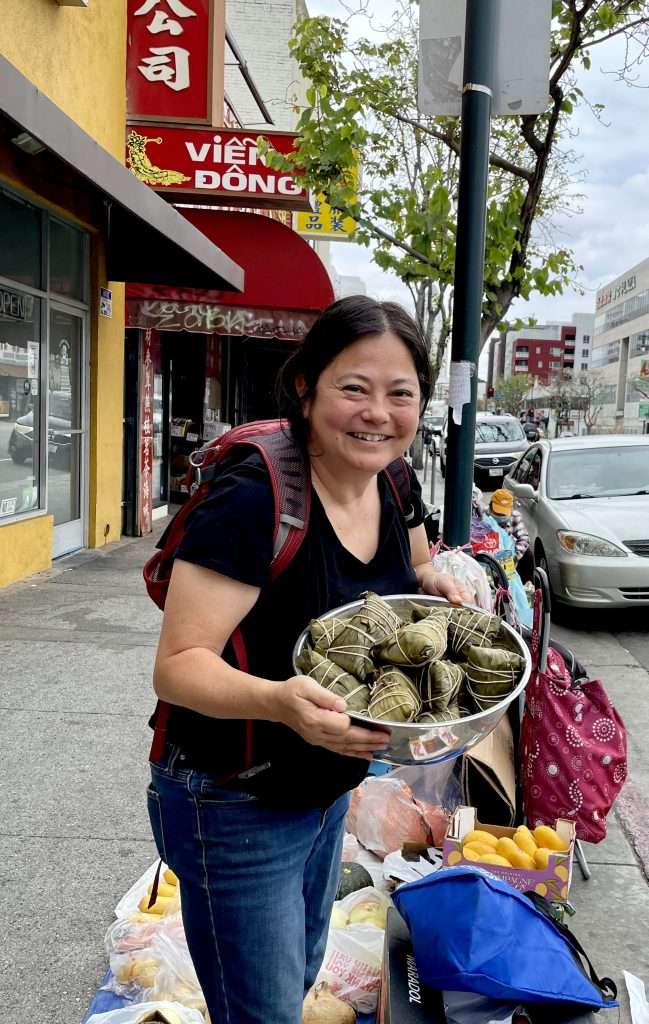
Just after writing this, I stumbled across a street vendor in LA Chinatown selling both the sweet and the savory Doong!


Por Por’s Recipe for Doong, told by Mom
Ingredients
- Ti leaves at least three for each doong
- Shelled water chestnuts cut into small pieces
- Boiled raw peanuts shells and skins removed
- Chinese sausage (omit for vegetarian) cut in small pieces
- Char Siu pork (sub Mushrooms if Vegetarian) cut into ¼-1/2 inch size
- Salted duck egg yolks about ¼ of a yolk
- Glutinous Rice Seasoned to Taste
- Lightweight twine to tie the leaves together
Instructions
Preparation
- The Ti leaves must be soaked for several days (mom used the bathtub), boiled in salt and vinegar to disinfect. Rinsed and drained. The leaves should be flexible.
- Salted duck eggs were always readily on hand. Raw eggs were disinfected (no doubt in a salt and vinegar solution). Salt water (I don’t know the proportion of salt to water) is boiled and cooled The whole, raw eggs were placed in the salt solution for probably several months. My mom made her salted egg brine in a glass gallon jug. Once the eggs are ready, the yolks (which are a little sticky) are used in this recipe. The egg white is a gooey consistency that can be used to season foods while cooking.
- Mom hand washed a large bag of glutinous rice. She then spread the rice out on trays to dry. My job was to pick through the rice and discard any debris or kernel that was discolored or didn’t look good. (What did I know about what looked good?) Usually the kernels that I discarded were those that had a solid looking white shade.
- The rice was soaked overnight in water. The next day it was seasoned with soy sauce and salt.
Assembling the Doong
- Once all the ingedients are cut, the assembling of the doong starts.
Making the pocket:
- Overlap two leaves. Gently fold horizontally in half (do not make a sharp fold or the leaves will tear.) About half way of the overlap, gently fold over vertically to form a pocket. Take a third leaf and wrap it around the upper part of your folded pocket and inserted in the vertical fold. (The pocket usually in your non-dominate hand.) All ingredients will be put into the pocket. The pocket size depends on the size of the leaves and how deep you make your folds.
Filling the pocket:
- Place about about 1/3 cup of rice in the pocket. Arrange all the other ingredients, one piece each, over the rice while firmly holding the pocket. Place another 1/3 cup rice over the ingredients.
The final fold:
- Taking the left side of the third leaf, fold over the food. You may have to tap your pocket so the ingredients will settle. Take the open end and snuggly fold over the rest of the pocket. Use twine to tie the leaves together in both horizontal and vertical directions to ensure that it does not open during the cooking process.
- The hardest part is how firmly to fold the leaves. If too loose, then the rice will not adhere with the ingredients and the cooked doong will not be firm. If the fold is too tight, the rice will burst through the leaves during the cooking process, making a mess.
- The Doong are cooked in boiling water for 4 to 6 hours. Mom used a gigantic pot with a rack that held the Doong (like for canning). The Doong are lowered into the boiling water and easily retrieved en mass once cooking is done. Cooled Doong may be refrigerated for a few days or frozen for a few months. In our home, we never had enough to freeze for a later.
Por Por was born in Canton and the only reason that she was married to Gung Gung was because her grandfather was terribly sick. The family thought that the happy occasion of a wedding would make him well again. They were married and her grandfather died anyways. Since Gung Gung was studying away at boarding school, their marriage wasn’t consummated for several years. The disapproval from her mother-in-law was heavy and Por Por was not allowed to sleep in the “marriage bed”. She would line up 4 chairs and sleep across them for many years until Gung Gung returned from school. She confided much later in life “I was so stupid for doing that!”


Mom moves closer to me as she tells her story. Looking over my computer as I jot notes quickly while she talks. Occasionally, she corrects something I write. “no, that’s not how the streets were then. It should read like this…” At one point she says, “No, I don’t think that happened”. I reply and say “Mom, you TOLD me that that happened. You wrote it down for me before”. Then from her, “Ok. I said that huh? Ok, then that must be what happened”. We laugh and she slips back into the past when I ask her what her fondest memories are related to Por Por and food. “She always made simple food at home. But every time we went home with you kids, she always made har gow or wonton so that there was always food for you guys when you came.”
Dad remembers that on every visit she would be making the har gow, small shrimp dumplings in a translucent steamed wrapper. Insisting that a dumpling maker wasn’t good if they didn’t have at least 8 or 9 folds (8 is long life, 9 is good luck). When Por Por made the dough for har gow she never measured. She would put a whole bag of rice flour and a whole bag of tapioca starch in a bowl and make a well in the center. Then she would slowly pour in boiling water and mix it into a dough before covering it with cheesecloth to rest. The dough is white when raw, but becomes delicate and translucent when steamed. The filling is made with chopped shrimp seasoned with Shaoxing rice wine and white pepper.

Por Por made black bean sauce with the pungent fermented black beans that were rinsed in cold water (always stirred clockwise), and bitter melon soup- an acquired taste to anyone not raised on it. Mom continues, “She always gave us the better food. When we had chicken she would always give us the breast and she would eat the tail saying ‘There’s a lot of meat in the tail’.” If you’re wondering, that special seasoning of Chinese chicken is called sacrifice.
The days of my childhood though were far off from the 1940s Chinatown trying to survive through the second World War. “I didn’t realize how lucky we were, but we ate very well despite the fact that Gung Gung didn’t earn a lot of money. In those days, the chef bought a whole side of cattle or pig and cut up the meat himself. Gung Gung bought our meat at wholesale prices and always brought home good cuts of meat and pork. So our family didn’t eat as typical Chinese families did.” Por Por would make salted duck eggs that would be mixed in with pork and water chestnuts. Mom remembers the sound as she whisked the salted eggs in with regular chicken eggs before adding to the pork. She would steam the whole mixture and they’d eat it over rice. This was a luxury of the day not often afforded. “In addition, Gung Gung used to bring home all the leftover dinner rolls. We had a lot of ham sandwiches on buttered dinner rolls for lunch. We kids absolutely hated it because all the other kids ate peanut butter and jelly sandwiches on white bread. All I could focus on was how different we were, and Por Por couldn’t convince us that we were fortunate.”
The luck didn’t always last though. Other times the poverty level left mealtimes very meager. Comfort food was a bowl of milk soup made from sweetened condensed milk mixed with boiling water and then topped with saltine crackers. This sweet, milky broth with salty, soggy crackers would become my mom’s comfort food, and later, mine.
TIME MOVES ON
Chinatown moved on through the years. Gung Gung liked the Chinese Opera. Listen to this old recording here. Mom and her brother would sometimes go with him to the theater under the Manhattan Bridge at East Broadway and watch the various Operas that were put on. They didn’t know what it was about. The actors didn’t sing, but rather “stretched their words in some different kind of cadence of sound.” Cantonese and lots of gongs and symbols. There’s nothing in that spot now where the Opera used to be. I can barely imagine it. And yet, Chinatown will never fail to provide something to eat. Food stalls wrap around the corner at that desolate part of the block on East Broadway.

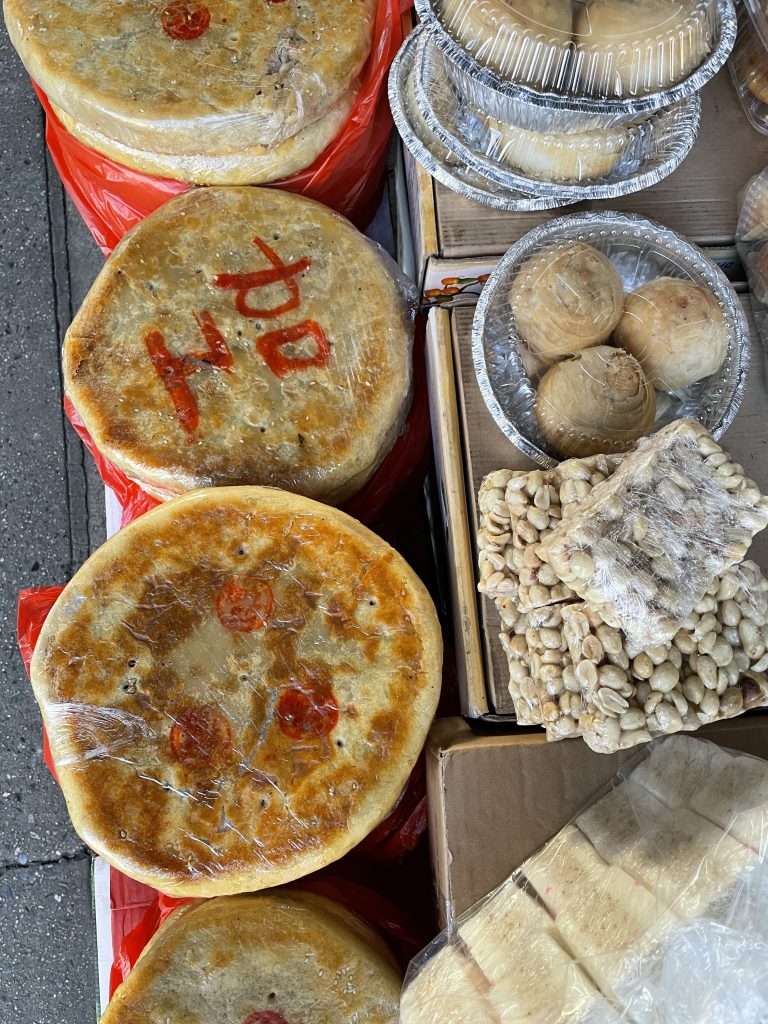
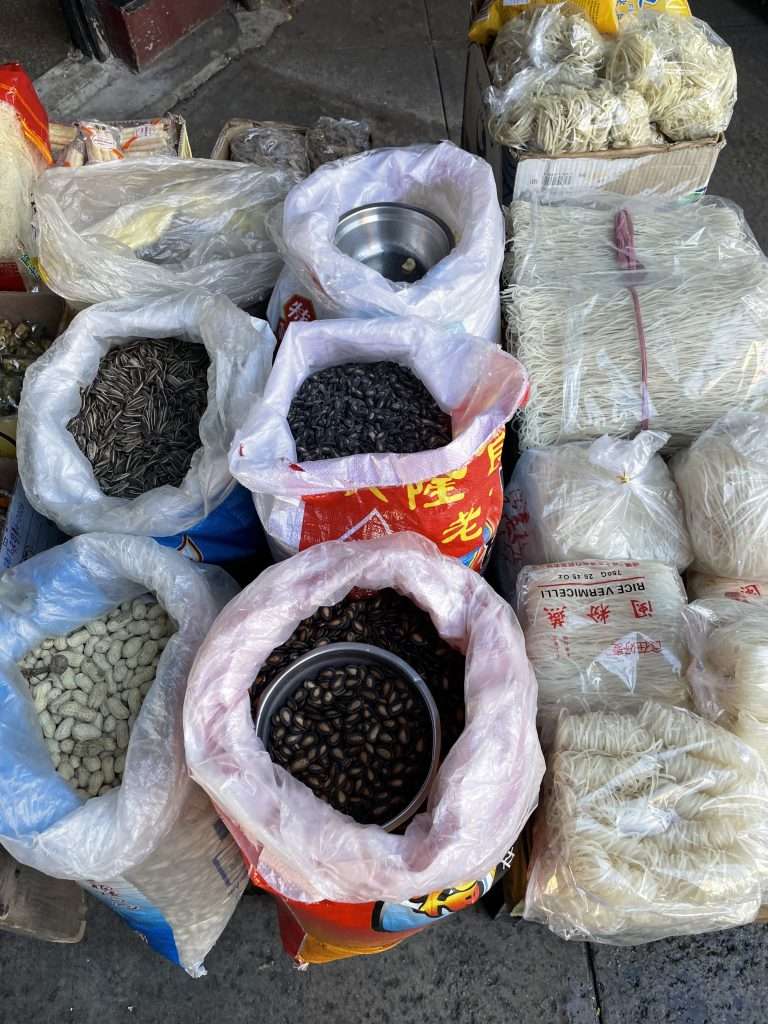
Por Por continued everyday life, climbing the 6 flights of stairs on Henry Street until her late 80s. She would make sticky rice flour dumplings [mochi] for special occasions. On Lunar New Year, for the Lantern Festival, she would make 2 kinds of these mochi balls. One, plain, and cooked in clear meat broth. The other, a sweet dumpling called Tangyuan [Cantonese], filled with sweet sesame. The round shape for both symbolizes family unity, completeness, and happiness.
The Lantern Festival (“Yuanxiao Jie”) is a traditional Chinese festival celebrated on the 15th of the first month of the lunar year, marking the end of the Chinese New Year. In China, on festival night, people go out onto the streets with lanterns under the full moon, watching lion or dragon dancers, playing Chinese games, and lighting up firecrackers. The festival isn’t celebrated much in the U.S., although every now and then you can find celebrations in some Chinese communities. I don’t know if there was ever a Lantern Festival in Chinatown.


Tangyuan (Yuanxiao in Mandarin)
Ingredients
- 4 ½ cups sticky rice flour
- water for mixing
- 7 oz butter
- 7 oz black sesame powder
- 8 oz sugar
- 1 tsp rice wine
Instructions
- Mix together the softened butter with sesame powder, sugar and wine
- Roll into small balls, about 0.3-0.4 oz each and set aside
- Using ½ cup of sticky rice flour, add enough water to make a smooth dough, loose enough that it lies flat, but not watery
- Cook the dough in boiling water for 2 minutes
- Remove when done and let cool to room temperature
- Place the cooked dough with the remaining sticky rice flour in a bowl
- Add enough water to knead into a smooth dough
- Roll the dough into 1 1/2 oz balls
- Make a hole in the ball and insert the sesame ball inside
- Fold the rice dough around the sweet sesame ball and seal by pressing edges together. Roll in hands to make smooth.
- Cook the finished dumpling in boiling water. Keep stirring in one direction while cooking. When the balls float to the top of the water, lower the heat and continue cooking for one more minute.
- Remove and let cool to room temperature. Eat.
Notes
DEATH, CHICKEN, AND PORK FOR THE AFTERLIFE
To restrain the sadness and accept the change in life. jié āi shùn biàn. When a loved one dies in the Chinese community there are a lot of rituals and traditions which help carry them into the afterlife. If tradition isn’t followed, it’s said to bring bad luck. Of course, food always plays a central role.
My grandfather died first. It’s common for the wake to take a week. The family sits with the body while visitors come to help mourn and bring offerings. Incense, fruit, and flowers often line the area around and in the coffin as things that they will take on their journey into the afterlife. It’s tradition for people to wail in grief. The wake and funeral are times of deep mourning, but the wailing is also a sign of respect and loyalty to the deceased. At my grandfather’s funeral, they hired a woman to wail while the family prayed. The Chinese believe that burning paper, called Joss paper, painted with gold and silver to represent money sends it with the deceased to have an abundant afterlife.
When we couldn’t be present in person, we would honor our deceased and send them gifts for the afterlife from home. Here we are folding paper boats, burning Joss paper, and burning incense.
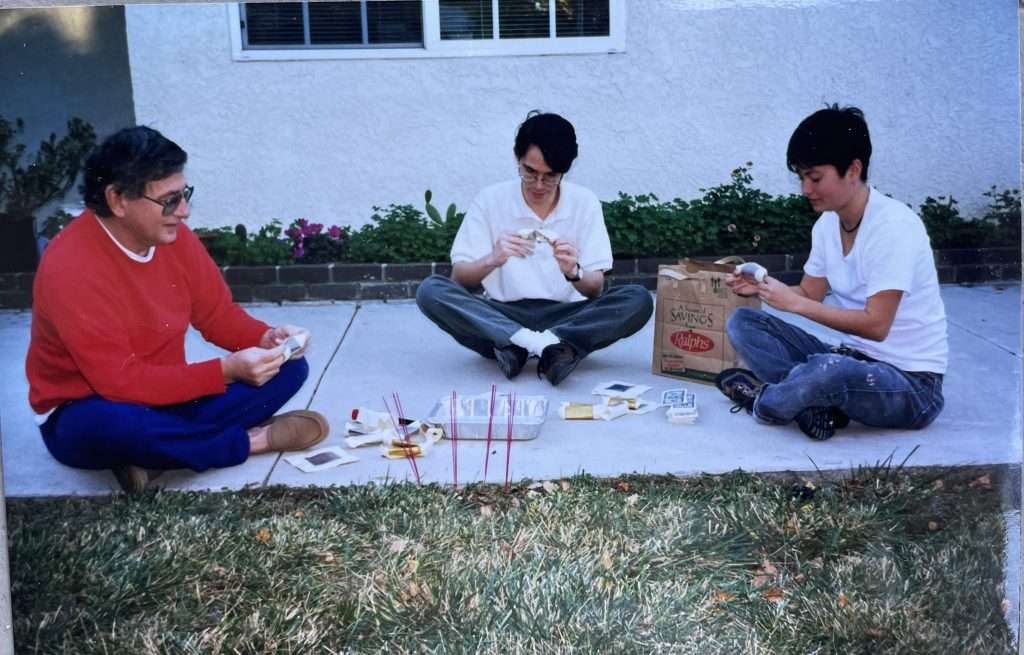
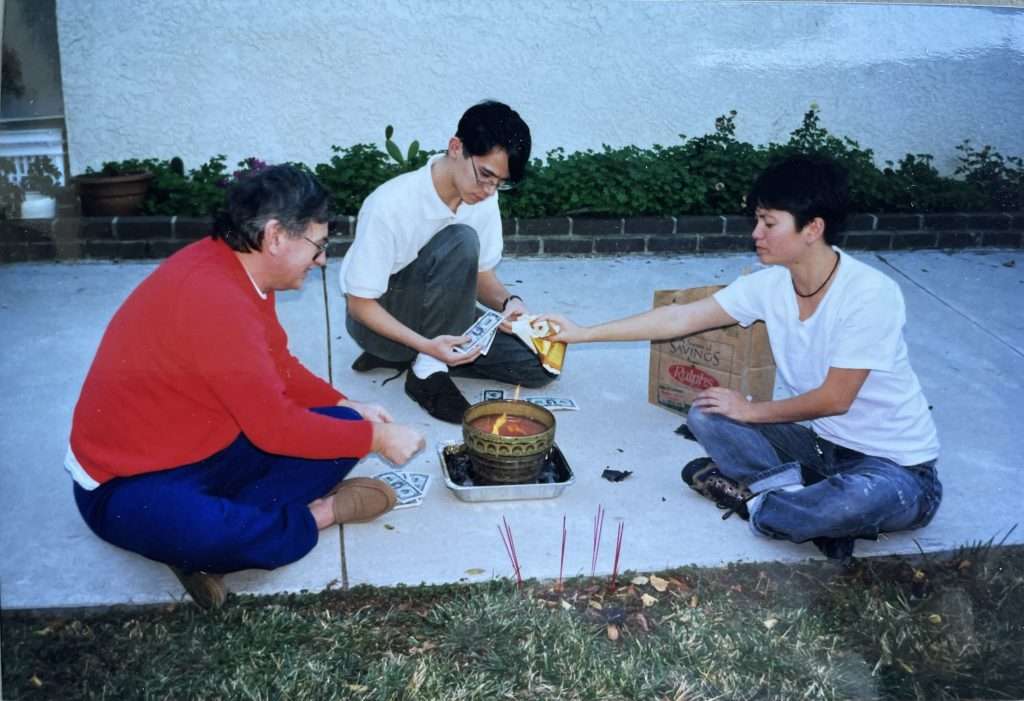
At one point, Mrs. Wu moved into a senior living apartment. They had an elevator, and the neighborhood was changing as the older generation died off. Everyone tried to get Por Por to move, but she never did. At my grandmother’s funeral we folded the Joss paper into origami boats to symbolize a safe journey into the afterworld. We did this for hours and I was grateful for something to do to pass the time. A brass brand played loud jazz in the back of the room to keep evil spirits away. My uncle, the oldest son, carried a giant incense as everyone walked. We wore black crocheted flowers on our sleeves to represent the mourning family.
In Chinese culture, it is customary to eat only vegetarian food the day before a funeral in order to save richer foods for the deceased. On the day of the funeral, a whole chicken and a thick slice of crispy pork are brought to the cemetery. Sometimes a bottle of rice wine and some glasses were set at the grave (although less often since people caught on that the Chinese cemetery is a place to get a meal and a drink). Chinese people believe that the soul of the deceased will visit 7 days after the funeral. The food is to ensure they aren’t hungry. Each year, and with each visit, chicken, fruit, and gifts are laid at the grave and incense is lit.

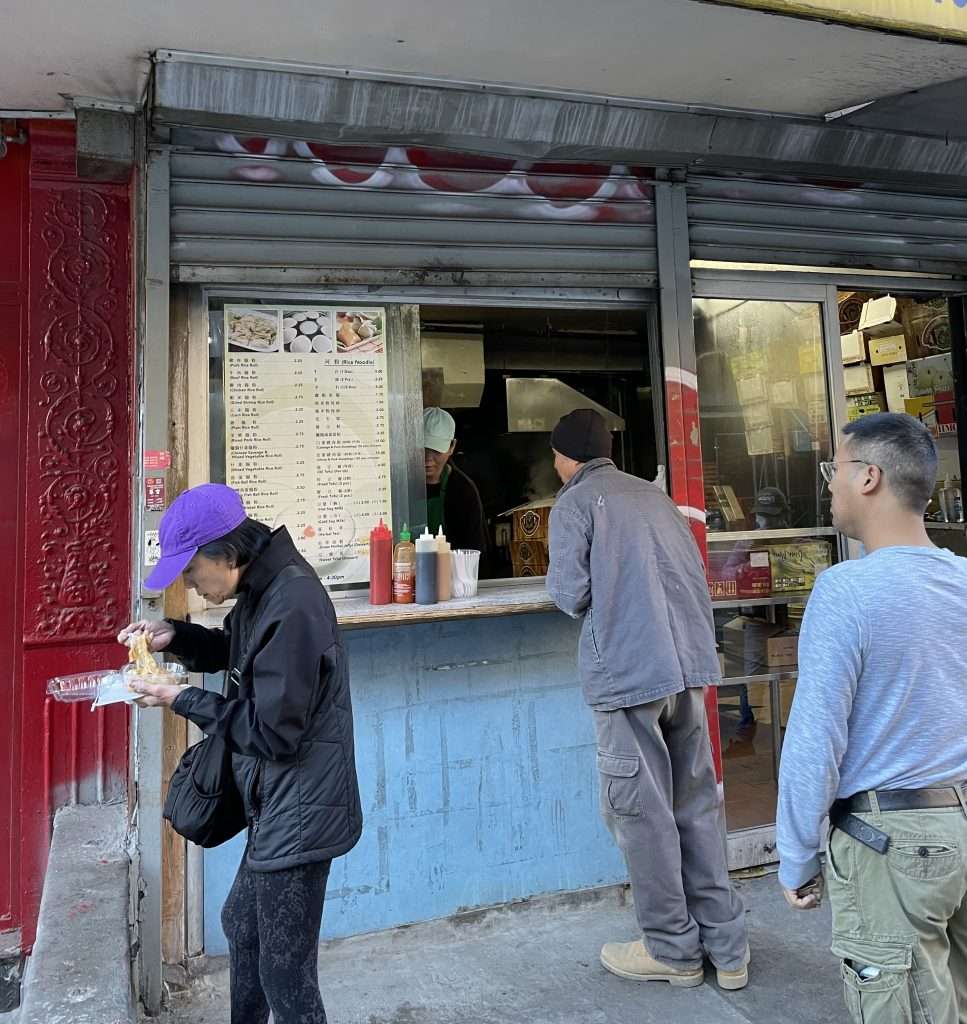
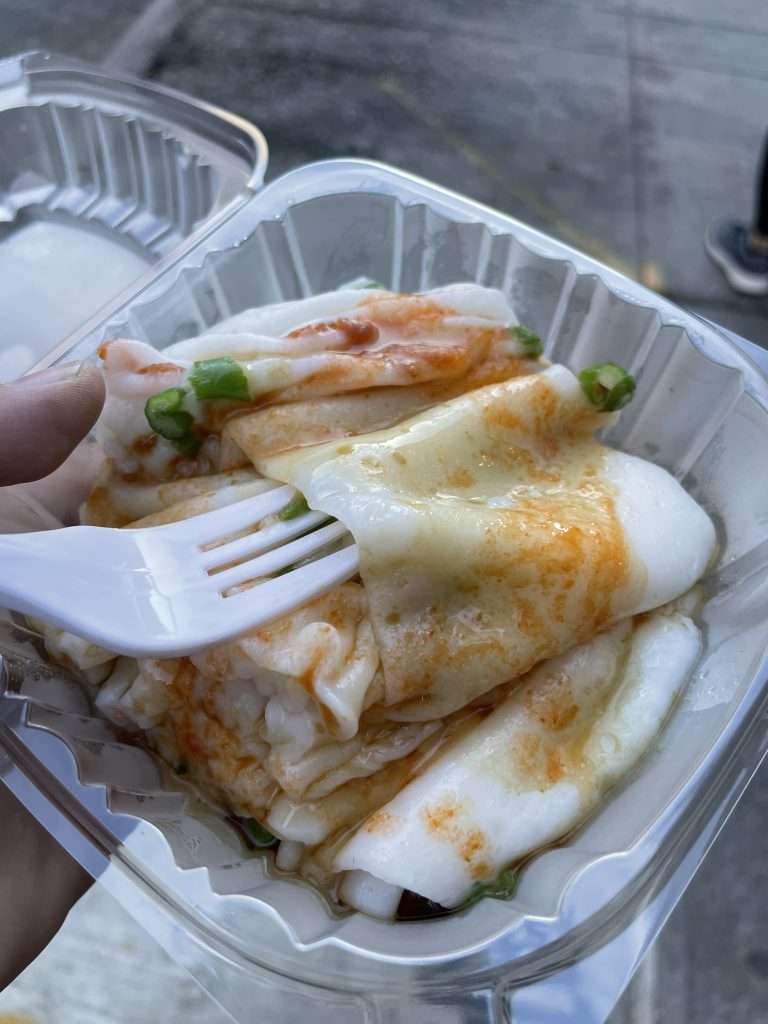
It’s much later now. I’m 52 years old and standing on the steps of the apartment building I no longer belong to. The noodle stand across the street is one you won’t know. If you get there early in the morning, the only people who will be there are a few elderly Chinese people from the neighborhood and some truck drivers. They’re in line waiting for a noodle dish- rice batter poured on a baking tray, sprinkled with corn, spring onions, dried shrimp, and Chinese sausage. Bottles of dark soy sauce, mustard sauce, and sriracha line the counter for your garnish. The tray is popped into a stacked steamer that looks like a large toaster oven and cooks within a minute. The woman at the window then takes a bench scraper and cuts and scrapes the mixture, creating a pile of freshly cooked rice noodles. It’s yours for $2.25. This is the Chinatown that everyone walks past. The streets where we live.